A Step-by-Step Guide to Launching Your Virtual Assistant Business
How to Land Your First Virtual Assistant Client: A Step-by-Step Guide
Starting a virtual assistant business is exciting, but let's be honest: figuring out how to actually land your first client can feel overwhelming.
You may be wondering:
What should I say when pitching a potential client?
Where do I find business owners who need help?
How do I position myself when I don't have years of experience?
What if no one says yes?
If you've been overthinking every move instead of taking action, this guide is for you.
Landing your first virtual assistant client isn't about having the perfect website, years of experience, or the fanciest packages. It's about knowing what you offer, clearly communicating your value, and confidently putting yourself in front of the people who need your help.
Let's break it all down.
Prefer to Listen Instead?
Listen to the full episode here:
Episode 53: A Step-by-Step Guide to Launching Your Virtual Assistant Business
Now, let's get into how you can start landing clients.
Step 1: Understand What Clients Actually Need
Clients don't hire virtual assistants just to say they have a team.
There is usually a real need in their business that needs to be filled in order for them to grow, save time, or operate more efficiently.
Business owners are busy. They may need help with:
Administrative tasks
Social media management
Inbox management
Client onboarding
Email marketing
Systems and automations
Project management
And that's where you come in.
As a virtual assistant, your job is to identify where you can provide support and clearly communicate the value you bring to a business.
The key isn't simply saying, "I'm a virtual assistant."
The key is being able to answer this question:
What problem do I solve for my clients?
Step 2: Identify Your Virtual Assistant Niche
One of the best ways to stand out as a virtual assistant is to become clear about your strengths and the services you enjoy providing.
Ask yourself:
What tasks do I actually enjoy doing?
What am I naturally good at?
What skills have I developed through previous jobs or experiences?
What problems can I help a business owner solve?
The more specialized you become, the easier it can be to communicate your value.
For example, there is a difference between simply offering general inbox management and helping a business owner implement automations that simplify their entire lead management process.
Both services are valuable.
However, specialization can help you become known for solving a specific type of problem.
Don't be afraid to niche down.
Niching down can help you:
Serve your clients better
Become more confident in your services
Create stronger offers
Attract clients looking for specific support
Increase your earning potential
You don't have to offer everything to everyone.
In fact, trying to do too much can make it harder for potential clients to understand exactly why they should hire you.
Step 3: Create a Clear and Compelling Offer
One of the biggest mistakes new virtual assistants make is simply introducing themselves by their job title.
Instead of saying:
"I am a virtual assistant."
Try communicating the transformation you help create.
For example:
"I help busy business owners manage their social media and inbox so they can focus on growing their business."
Do you see the difference?
The second statement tells a potential client:
Who you help
What you help them with
The benefit of working with you
Creating a compelling offer becomes easier when you understand your ideal client's current situation.
Ask yourself:
What does their business look like right now?
What challenges are they experiencing?
What tasks are taking up too much of their time?
Where do they want their business to grow?
How can my services help them get there?
Put yourself in their shoes.
Then create an offer that helps solve their problem.
A simple framework to use is:
Who do I help?
What do I help them do?
Why do they need my help?
When you can confidently answer those questions, creating your services and packages becomes much easier.
Step 4: Show Up as an Expert
You don't need ten years of experience to show up confidently in your business.
Confidence is one of the biggest things that can impact your ability to sell your services.
I've met women who were more educated, more experienced, and had more polished websites than me.
But confidence matters.
You have to believe in the value you bring to a client's business.
You have to believe that your skills, personality, experience, and approach make you uniquely qualified to help someone.
That doesn't mean pretending to know things you don't know.
It means owning what you do know.
If you're just starting out, don't allow your lack of experience to make you shrink.
Show up prepared.
Know your services.
Understand the problem you solve.
And walk into conversations believing that you can help.
Confidence can be developed through action.
The more conversations you have, pitches you send, and sales calls you take, the more confident you will become.
Step 5: Know Where to Find Virtual Assistant Clients
Now that you know how to position yourself, let's talk about where to actually find potential clients.
Here are four places to start.
1. Facebook Groups
Facebook groups can be a great place to connect with entrepreneurs and business owners.
The key is to provide value before constantly pitching your services.
Many Facebook groups have rules against self-promotion, and you should always respect those rules.
However, business owners often post when they're actively looking for help.
When that happens, that's your opportunity to introduce yourself and pitch your services.
You can also build visibility by:
Answering questions
Sharing helpful tips
Documenting your work
Talking about projects you're working on
Demonstrating your expertise
There are plenty of ways to showcase what you do without directly posting, "Hire me!"
Growing a business will teach you how to get creative.
Use that creativity when connecting with potential clients.
2. Instagram and LinkedIn
Your next client could literally be a DM away.
Make sure your Instagram and LinkedIn profiles clearly communicate what you do and who you help.
Then start having conversations.
One of the biggest fears I see with new virtual assistants is being afraid to reach out and talk to business owners.
But conversations are the foundation of your business.
You need to get comfortable communicating with potential clients.
Use your content and stories to encourage engagement.
Try using:
Polls
Question boxes
Interactive stories
Conversation-starting posts
Then use those interactions as an opportunity to genuinely connect with people.
Help them when possible.
Learn about the challenges they're facing.
And when appropriate, introduce your services as a possible solution.
DMs are not scary.
Sometimes it's simply your mindset around selling and conversations that makes them feel intimidating.
3. Freelance Platforms and Cold Outreach
Platforms like Upwork can connect you with potential clients.
However, you need to be careful.
There are scams on freelance platforms, and new virtual assistants can easily find themselves in situations where they're asked to work without proper protection.
If you use freelance platforms, make sure you:
Have a signed contract
Understand the terms of the project
Receive appropriate payment protection or upfront payment
Research potential clients
Cold outreach is another strategy that is often overlooked.
When done correctly, cold outreach can help you start conversations with business owners who may genuinely need your services.
I personally signed two clients within 10 days of starting my virtual assistant business.
My first client came from sending a cold email to a business owner.
I identified areas of their website that could be improved and explained how those improvements could benefit their business.
That conversation led to a sales call.
And that sales call led to my first client.
Cold pitching works, but your pitch has to be thoughtful.
Which brings us to the next step.
4. Your Personal Network
Don't forget about the people who already know you.
Let people know what you do.
Tell:
Former coworkers
Friends
Family members
Previous clients
Professional contacts
Other business owners
Referrals can be incredibly valuable.
Sometimes the warmest leads come from someone recommending you to a business owner who already needs your services.
Don't be afraid to ask people for referrals.
You can even create a referral incentive for people who send clients your way.
The people in your existing network may not need a virtual assistant themselves, but they may know someone who does.
Step 6: Create a Winning Virtual Assistant Pitch
If you're going to reach out to potential clients, your pitch needs to stand out.
Here are three things every strong pitch should include.
1. Personalization
Never send a generic message that says:
"Hey, I'm a VA. Do you need help?"
Your potential client probably receives messages like that all the time.
Instead, personalize your outreach.
Mention something specific about:
Their business
Their website
Their recent content
Their services
Their client experience
You want them to see that you're a real person who actually took the time to learn about their business.
Personalization creates connection.
2. A Clear Value Proposition
Don't just tell them what services you offer.
Explain how those services can help solve a problem.
For example, maybe a business owner is spending hours every week managing client onboarding.
Instead of simply saying:
"I offer administrative support."
You could explain how your support could help them streamline their onboarding process and spend more time doing what they originally started their business to do: serving their clients.
Focus on the result.
What will improve when they work with you?
What problem will be removed from their plate?
What opportunity will they have more time to focus on?
That's the value you're selling.
3. A Clear Call to Action
Always tell your potential client what to do next.
Don't end your pitch and hope they figure it out.
Give them an easy next step.
For example:
"Would you be open to hopping on a quick 15-minute call this week to discuss how I may be able to help?"
A call to action gives the conversation direction.
And ultimately, getting potential clients on a call gives you an opportunity to learn more about their business and position your services as the solution.
A Simple Virtual Assistant Pitch Template
Here's a simple framework you can use when reaching out to potential clients:
Hi [Name],
I love what you're doing with [Business Name or something specific about their business].
I noticed that you may need support with [specific task or area].
I specialize in helping business owners with [your service or specialty], and I'd love to explore whether I could help take some of that work off your plate.
Would you be open to a quick 15-minute call this week?
Remember: personalize this message.
Don't copy and paste the exact same pitch to every business owner.
Take the time to understand their business and make the message relevant to their needs.
Step 7: Focus on Their Needs During the Sales Call
Getting someone on a call is only the beginning.
When you get on a discovery or sales call, focus on understanding their business.
Ask questions about:
Their current challenges
What's taking up most of their time
What systems aren't working
What tasks they need help with
Where they want their business to grow
Then listen.
Once you understand their needs, position your services as the solution.
The conversation shouldn't be all about you listing every skill you have.
It should focus on how you can help them solve the problems they're currently experiencing.
Clarity and confidence make a huge difference during the sales process.
Your First Virtual Assistant Client Is Waiting for You to Take Action
Today, we've covered:
How to position yourself as a virtual assistant
Why niching down can help you stand out
How to create a clear offer
Where to find potential clients
How to pitch business owners
What to focus on during sales calls
But none of this works if you don't take action.
You can spend weeks researching how to start a virtual assistant business.
You can create the perfect website.
You can redesign your packages.
You can wait until you feel completely confident.
But eventually, you have to put yourself out there.
Send the email.
Start the conversation.
Join the Facebook group.
Post the content.
Pitch the client.
Your first client isn't going to appear because you have the perfect logo or website.
They're going to find you when you start showing up and letting people know how you can help.
Building a successful virtual assistant business takes strategy, confidence, and consistent action.
If you're ready to land clients and build a business that gives you more flexibility, freedom, and income, you don't have to figure it all out alone....
That's exactly why I created The VA University™. 🎓
Inside The VA University™, I walk you step-by-step through building your virtual assistant business—from setting up your foundation and identifying your services to pricing your packages, marketing your business, finding clients, navigating the sales process, setting up your systems, and onboarding your clients.
You don't need another 47 saved Instagram posts telling you how to become a VA.
You need a roadmap.
Class is officially in session. 🎓
Prefer to listen instead?
CLASS IS IN SESSION!
Ready to turn the skills you already have into a profitable virtual assistant business?

I'm Neka
I help ambitious women turn the skills they already have into profitable, structured service businesses so they can create consistent $3K–$5K+ months without burnout, chaos, or sacrificing their family life.
popular








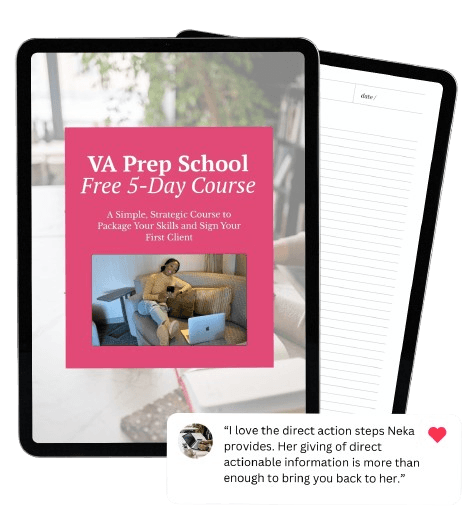
Ready to start your VA business?
Get the 5-day course that turns skills into income.







©NEKA WILLIAMS 2026 | SITE TEMPLATE BY RISEFUNNELS | PRIVACY | TERMS